
Printing services help businesses produce professional marketing materials, promotional products and branded assets that strengthen brand visibility and communication. From brochures and flyers to packaging and signage, the printing method used can influence quality, cost and turnaround time. Understanding the printing process and the commercial printing process allows businesses to select the most suitable printing service for their needs.
Commercial printing includes services such as digital, offset, screen, and large-format printing. Each method uses different equipment and techniques to transfer images and text onto materials. Before production begins, professional printers usually provide a print proof, allowing businesses to review the layout, colours, and design details before the final print run.
Why printing services remain important for business marketing
Printed marketing materials continue to play an important role in business promotion. Leaflets and Flyers, brochures, posters and signage create a physical connection with customers and reinforce brand identity. Unlike digital content, printed materials can remain visible in offices, stores and homes for long periods, increasing brand exposure.
Professional printing also improves credibility. When a business distributes well-designed brochures or uses high-quality business cards, it communicates professionalism and reliability. Commercial printing services, therefore, support marketing campaigns, product launches and everyday brand communication.
Studies consistently show that printed advertising remains effective. Research indicates that around 80 per cent of consumers respond to print advertisements, compared with roughly 45 per cent for digital marketing. This demonstrates that print continues to influence purchasing decisions and brand recognition.
What is the printing process in commercial printing?
The printing process is the method used to transfer text, graphics, or images onto materials such as paper, plastic, fabric, or packaging surfaces. In commercial environments, specialised printing equipment ensures that each print run maintains consistent colour, alignment and quality.
Most printing projects begin with preparing digital artwork. The printer then produces a print proof, which allows the client to check layout accuracy and colour consistency before printing begins. After approval, the printing equipment applies ink or dye to the material using the selected printing technology.
Understanding the commercial printing process helps businesses choose the right printing solution. The correct method ensures the final printed materials meet brand standards while maintaining production efficiency.
Digital printing
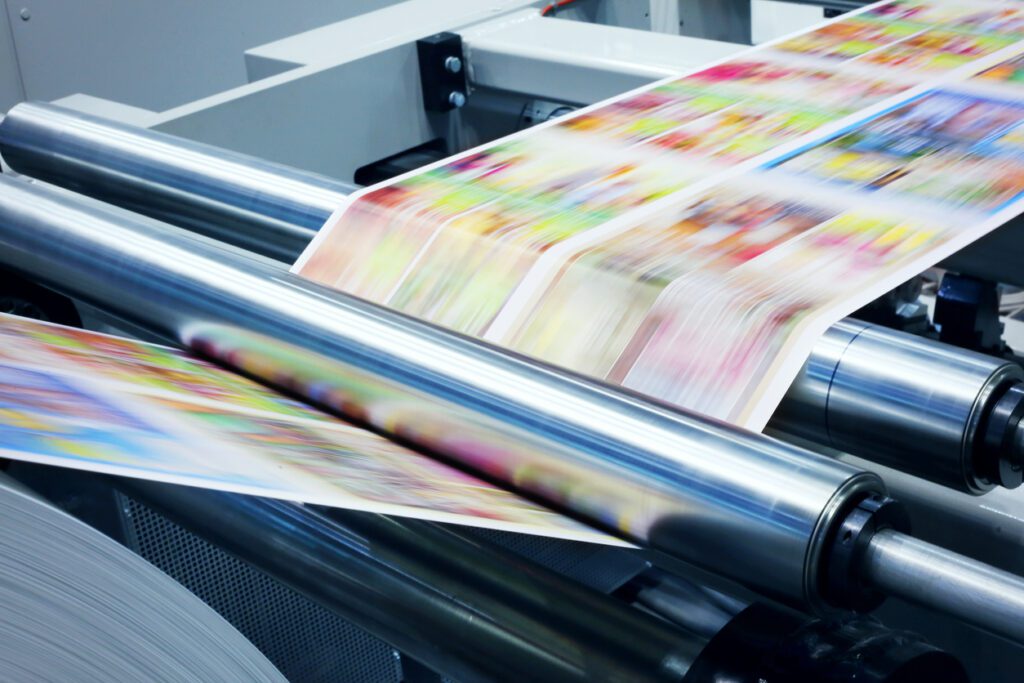
Digital printing is one of the most widely used printing services for business marketing materials. Digital printing is a low-cost form of printing in which materials are printed directly from electronic files, in either black and white or colour.
This method is commonly used for brochures, leaflets, flyers, posters and business cards because it allows quick production and easy customisation. Businesses can print smaller quantities without the high setup costs associated with other printing methods.
Digital printing also allows faster turnaround times because the design files are sent directly to the printer. This makes it ideal for short marketing campaigns or urgent printing requirements.
Offset printing
Offset printing, also called offset lithography, is widely used in the commercial printing process for large-volume production. In this method, inked images are transferred from a metal plate to a rubber blanket before being applied to the printing surface.
Offset printing produces highly consistent results and excellent colour accuracy. It is commonly used for newspapers, magazines, catalogues and large marketing campaigns where thousands of copies must be produced.
Although offset printing requires a longer setup process, it becomes more cost-effective for large print runs. Businesses often choose this method when they need high-quality prints at scale.
Screen printing
Screen printing is commonly used for apparel printing and promotional merchandise. In this printing process, ink passes through a mesh screen to transfer each colour of a design onto the material surface.
This method works well on textiles, glass, plastic and wood. Screen printing produces strong, vibrant colours and durable prints that last through repeated use and washing.
Because the setup process involves preparing individual screens for each colour, screen printing becomes more efficient when producing larger quantities of products such as branded clothing or promotional items.
Large format printing
Large-format printing is used to produce oversized materials designed to attract attention. These prints are typically larger than standard document sizes and are used for advertising displays and promotional graphics.
Businesses often use large-format printing for banners, billboards, posters, and exhibition signage. The size and visual impact of these prints help businesses communicate marketing messages in public spaces.
Large format printing allows high-resolution graphics to be produced on materials such as vinyl and specialised display surfaces.
LED UV printing
LED UV printing is a modern commercial printing technology that uses ultraviolet light to instantly cure ink during printing. LED UV printing is a flatbed printing process in which ultraviolet radiation dries the ink immediately as it is applied.
LED UV printing is widely used for signage, promotional displays and customised products that require durable finishes. It prevents smudging and produces sharp, vibrant images.
Inkjet printing
Inkjet printing sprays tiny droplets of ink onto paper to produce detailed images and text. This printing method is commonly used for smaller printing jobs and photographic printing.
Inkjet printers provide high-quality colour reproduction and detailed images. However, ink cartridge costs can make large print runs more expensive compared with commercial printing technologies.
For smaller quantities or high-quality image printing, inkjet printing remains a practical option.
Laser printing
Laser printing uses toner and heat to produce printed documents quickly and efficiently. Laser printers are commonly used in offices because they print large volumes of documents at a relatively low cost per page.
This printing method is faster than inkjet printing and is suitable for everyday document printing. Although colour reproduction can be limited compared with specialised printing technologies, laser printing remains reliable for business documentation.
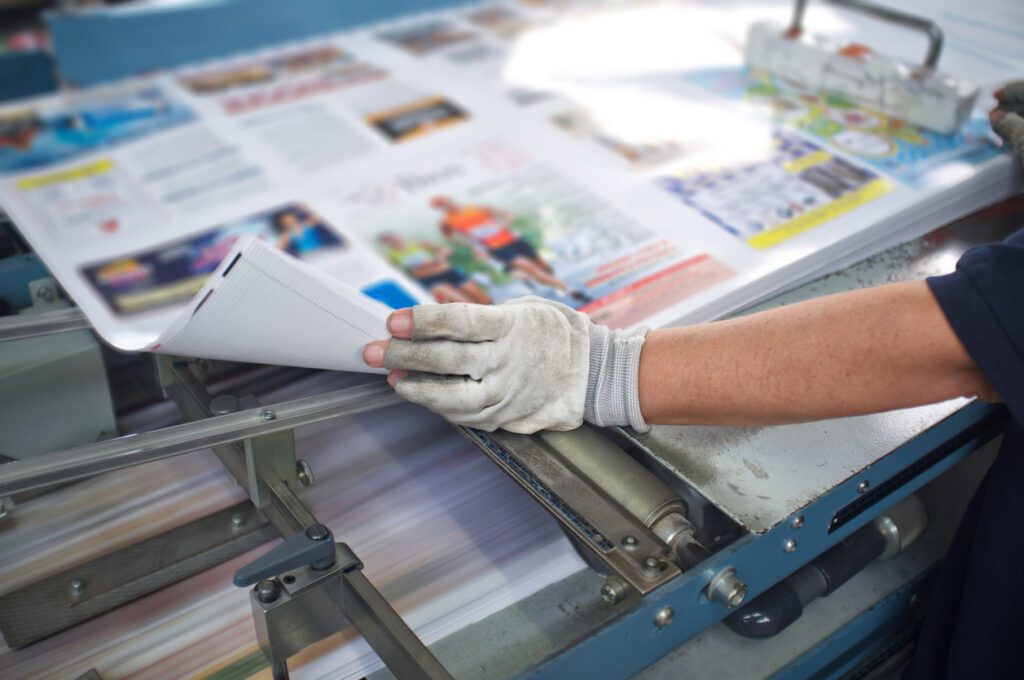
Need Professional Printing for Your Business? Speak to TR2 Creative!
High-quality print can transform how customers see your brand. Whether you need brochures, signage, promotional materials or large-format displays, the right printing solution ensures your marketing materials look professional and deliver impact.
Contact the team at TR2 Creative today to discuss your printing project and create print materials that strengthen your brand and attract more customers.
FAQs
How do businesses choose the right printing service?
Businesses choose printing services based on the type of material, quantity required and the desired finish. Digital printing works well for short print runs and fast turnaround times, while offset printing is more suitable for large quantities where consistent colour and lower unit cost are important. For promotional merchandise or textiles, screen printing often provides the most durable results.
Which printing method is best for marketing materials?
The best printing method depends on the type of marketing material being produced. Digital printing is commonly used for flyers, brochures and business cards because it allows quick production and flexible quantities. Large-format printing works best for banners, posters, and exhibition graphics where size and visual impact matter most.